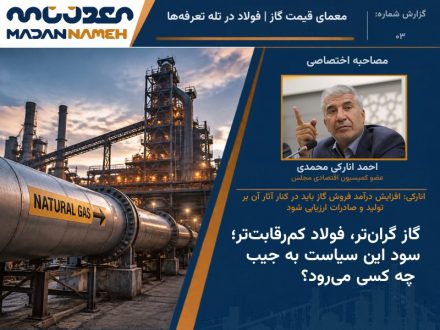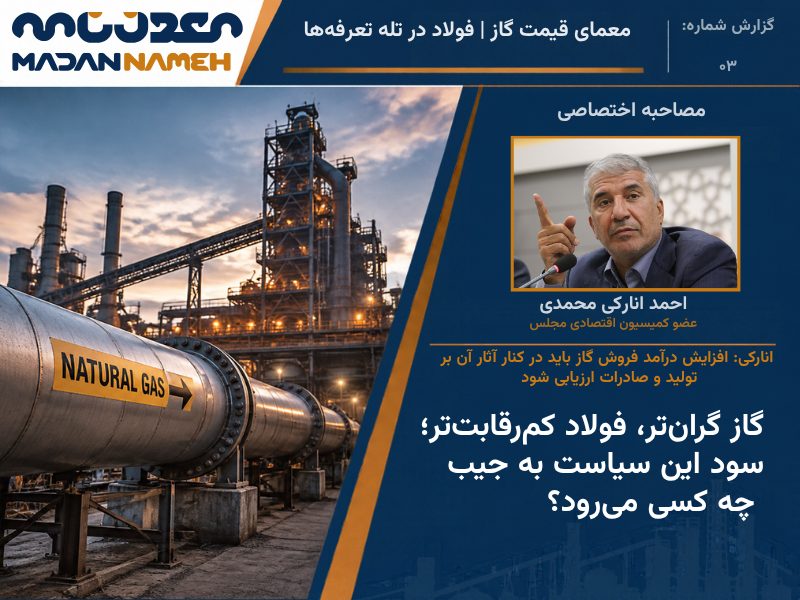
According to the Mining News Agency, the increase in gas costs and the tightening of energy supply restrictions have placed Iran's steel industry in a situation where the issue is no longer just the increase in factory bills. Energy costs are now directly related to the production costs of products, the profitability of production units, the implementation of development plans, and Iran's ability to participate in export markets.
Ahmad Anarki Mohammadi, the representative of the people of Rafsanjan and Anar and a member of the Economic Commission of the Islamic Consultative Assembly, emphasized the necessity of simultaneously examining the effects of increasing gas tariffs on industrial unit activities and revenues from exports in an interview with the Mining News Agency, highlighting the role of energy in production economics.
This concern arises at a time when gas supply restrictions for some steel units began around November 10. Vahid Yaghoubi, the executive assistant of the Iranian Steel Producers Association, announced on November 30 that gas restrictions in some units have reached 25 to 40 percent. He also warned of the likelihood of these restrictions intensifying in late December and in the months of January and February. Thus, steel producers may face not only higher energy costs in the coming months but also reduced access to the necessary gas for production lines.
Maintaining export markets becomes more difficult with rising energy costs
Anarki noted that the total cost is one of the determining factors for the competitiveness of producers in international markets, emphasizing the importance of exporting steel products for the country's economy.
According to him, the Iranian steel industry benefits from access to natural gas resources and the development of production capacities based on direct reduction technology, advantages that are essential to maintain for continued presence in export markets. The increase in energy costs, especially when Iranian producers are also facing transportation costs, financing challenges, and difficulties in trade exchanges, could weaken their competitive position.
This issue is particularly important in the steel export market. An Iranian producer cannot transfer every increase in cost to the foreign selling price. Buyers in the global market choose among various suppliers, and factors such as price, quality, timely delivery, and supply stability play a role in their decision. Therefore, the simultaneous increase in gas costs and energy supply constraints can affect exports in two ways: first, by raising production costs, and second, by reducing production capacity and making it more difficult to meet export commitments.
Anarki believes that the effects of gas tariff increases should be examined in terms of the production costs of export products and the profits obtained from foreign sales. According to this member of the Economic Commission of the Parliament, steel exports are not limited to just selling the product; they are also related to currency generation, maintaining foreign markets, employment, and utilizing the capacity of the country's industrial investments.
From this perspective, the economic evaluation of gas tariffs should not be limited to the amount of revenue generated from energy sales. It is necessary to determine how changes in the price of this input affect the added value of production, the competitiveness of products, and the country's export revenues.
Producers need tariff stability, not just information about today's prices.
Another emphasized point by Anarki is the necessity of stability and predictability in economic and energy policies.
For a steel unit, knowing the gas rate at a specific point in time is not enough. The factory must be able to forecast energy costs in its production, sales, and investment plans. This necessity is even more significant for development projects since return on investment in the steel industry depends on multi-year periods, and unforeseen changes in energy costs can impact the economic calculations of a project.
The representative of the people of Rafsanjan and Anar emphasized the transparency of pricing principles, the clarity of tariff review periods, and the timely announcement of changes to industrial units. He believes that using long-term contracts and predictable mechanisms for gas supply can help producers in financial planning and investment decision-making.
In addition to the issue of price, the limitation of gas supply also imposes independent costs on the factory. When production decreases, the fixed costs of the industrial unit are divided among a smaller amount of product, resulting in an increase in the cost price of each ton. Stopping and restarting production lines may also incur additional technical and operational costs.
In such circumstances, the producer is faced not only with an increase in gas tariffs but also with the costs arising from reduced factory activity capacity. Therefore, stability in energy delivery is as important as its price predictability.
Support for production should not be limited to the provision of bank facilities.
In another part of this conversation, Anarki emphasized the necessity of transparency in the sources and mechanisms for supporting industrial units.
According to him, before implementing support programs, it should be specified which units will be eligible for support, where the required financial resources will come from, and to what extent these supports can help sustain production and maintain employment.
From the perspective of this member of parliament, a combination of correcting imposed costs and targeted financial support could be more effective than solely relying on bank facilities.
This issue is particularly important as the increase in energy costs, reduction in production, and export restrictions can lead to a liquidity shortage for factories. Working capital loans may alleviate part of this pressure, but if the main factors for cost increases persist, merely obtaining loans will not resolve the economic issues of the production unit.
Therefore, in designing support policies, a distinction should be made between compensating for the damages done to businesses and correcting the conditions that cause a continuous increase in production costs. Financial support will be more effective when, alongside it, there is a specific program to maintain production stability and prevent the recurrence of economic pressures.
Gas tariffs must be measured against the overall benefits of the economy.
The discussion around gas prices in the steel industry goes beyond the relationship between the energy supplier and the consuming factory. An increase in tariffs may generate more revenue from gas sales, but evaluating the economic outcome requires examining the potential impacts on production, exports, employment, profitability of firms, and tax revenues.
Anarki believes that the Economic Commission of the Parliament should examine the issue of gas tariffs from the perspective of this entire set of effects to determine what impact energy pricing policy will have on the country's economy.
If the increase in gas rates is accompanied by reduced production, falling exports, or limited investment, one cannot determine its success solely based on the growth of income from energy sales. Conversely, keeping gas prices low without regard to the actual costs of production, refining, transmission, and development of infrastructure cannot be a sustainable solution either.
The issue is to achieve a mechanism that considers the costs of energy provision but does not undermine the advantage of industrial production due to sudden and unpredictable changes.
This issue is even more critical for Iran's steel industry, as a significant portion of the country's production capacity is based on direct reduction and natural gas plays a vital role in the production of sponge iron. Consequently, the future competitiveness of steel is not solely dependent on the nominal capacity of factories, access to iron ore, or the volume of investment; sustainable energy provision and the ability to predict its cost are also decisive for the continued operation and development of this industry.
Anarki's statements come at a time when steelmakers are facing both rising energy costs and physical limitations in gas supply. Such a situation intensifies the need to examine the impacts of tariffs in specialized committees of Parliament.
The main question now is whether gas pricing policy can supply the necessary resources for the development of energy infrastructure while maintaining the competitive advantage of industries that significantly rely on access to this energy for their investment and export capacity.
For Iran's steel industry, answering this question is not limited to the tariff per cubic meter of gas. What matters is the actual cost of producing each ton of product, the stability of factory operations, and the ability to compete in domestic and foreign markets. Energy policy serves national interests when, alongside meeting the gas sector's needs, it also facilitates the continuity of production and the maintenance of the country's export markets.