
Story views: 5
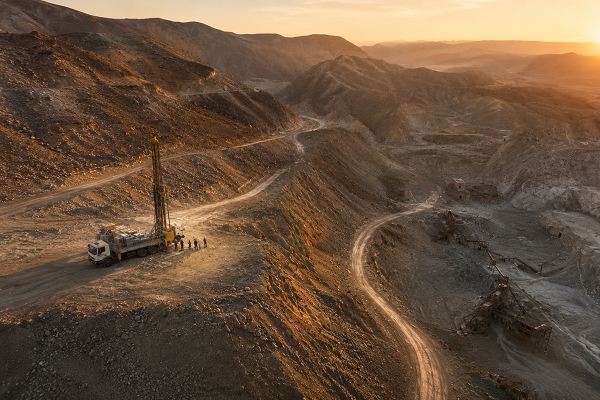
Mohammadreza Ebrahimi, Managing Director – In the recent IMIDRO meeting, the goal-setting of “one million meters of drilling” was presented more as an emphasis on developing exploratory operations and exploratory drilling within the subsidiary and affiliated companies of this organization, rather than direct entry into the extraction and exploitation phase. This distinction must be carefully considered because in mining terminology, exploratory drilling is fundamentally different from extraction. Exploratory drilling is conducted to identify reserves, determine ore grade, examine the depth and extent of the mineral, complete geological data, and convert a promising area into an assessable project. Extraction, however, takes place only after the mine has passed through exploration, discovery certification, design, obtaining an exploitation license, and operational preparation stages.
From this perspective, IMIDRO’s announced program should first be understood as a program for activating, deepening, and standardizing exploration, not necessarily a plan for immediate allocation of new areas or commencement of extraction in new mines. The meeting minutes also indicate that the main emphasis was on monitoring the actions and exploration programs of IMIDRO’s major subsidiary and affiliated companies. Therefore, the correct interpretation is that the target of one million meters of drilling currently mainly refers to projects, areas, exploration zones, and programs either in possession of or under the control of IMIDRO’s affiliated and subsidiary companies.
Nevertheless, if this program remains confined merely to previous projects, current zones, and ongoing activities of subsidiary companies, it will not adequately address the crisis in raw materials, the lag in exploration, and the weak investment in the country’s mining sector. The importance of the recent IMIDRO meeting lies precisely at this point: this meeting could mark the beginning of a new phase in the country’s exploration policy, provided that it moves beyond merely monitoring existing programs and proceeds to design a broader mechanism for determining the fate of inactive zones, targeted allocation of new areas, attracting real investment, and linking exploration directly to the needs of the mining industries.
Therefore, the suggested approach does not reject IMIDRO’s current plan but rather complements it. The first phase should involve a precise monitoring of existing zones, projects, and exploration programs, which means identifying which companies have actually conducted drilling, which zones are active, which areas only exist in administrative documentation, and which projects have stalled due to financial weakness, lack of equipment, absence of technical planning, or managerial lack of motivation. Without this initial filtration, any new allocations may just repeat the old cycle: acquiring zones, holding licenses, performing minimal operations, and awaiting an increase in the license’s value.
The second phase must decide on inactive, semi-active, or non-progressing zones. A mining zone is a national asset and must not become a dormant asset of companies. If a company—whether state-owned, semi-state, or private—has failed to meet its exploration commitments within a specified timeframe, the zone must be reclaimed through a transparent, no-exception mechanism. Reclaiming inactive zones should not be viewed merely as punitive but as part of proper mining governance. A country facing raw material crises, shortages of new reserves, declining grades of old mines, and increasing demand in steel industries cannot afford to keep its promising zones in limbo.
The third phase involves targeted allocation of new or reclaimed zones to actual and capable consortia. One of the most practical and rational methods at this stage is to involve steel companies in exploration and mine development. Steel companies, especially those seriously concerned about securing iron ore, coal, raw materials, and future feedstock, have a much stronger motivation for entering exploration than many holders of nominal licenses. Steel producers understand that their factories’ futures, production capacity, profitability, exports, and even industrial survival depend on raw material security. Thus, smart allocation of zones to steel companies or steel consortia can transform exploration from an administrative task into an industrial necessity.
Of course, this allocation should not be limited to a few large, well-known companies. Alongside major steelmakers, many small and medium steel companies also face challenges in securing stable raw materials but lack the financial, technical, and managerial capacity to undertake large exploration and mining projects alone. The solution is to form regional consortia. IMIDRO can identify the capacities of steel companies by holding regular joint meetings with the Iranian Steel Producers Association. The Steel Association, based on factors such as factory location, raw material needs, financial capability, production history, and readiness to participate, can introduce several small and medium steel companies to participate in mining consortia.
In this model, zones are categorized according to geographic location and steel supply chain needs. For example, steel companies located in one area or near a mining zone, under the guidance of the Steel Association and the supervision of IMIDRO, can form a joint consortium. This consortium shares exploration costs such as geophysics, drilling, laboratory testing, technical consulting, modeling, and initial infrastructure among its members. Such a mechanism reduces each company’s investment risk while preventing concentration of zones in the hands of a few limited players. The result could be a more balanced, fairer, and more operational model for steelmakers’ participation in future exploration and extraction.
IMIDRO’s role needs to be clearly defined in this process. IMIDRO should not merely act as a licensor and leave the projects unattended after signing agreements. This organization should serve as a leader, supervisor, standard-setter, national data owner, and regulator of relationships among companies. Likewise, the Steel Association should not simply provide a list of companies; it must participate in eligibility assessments, consortium mechanism design, commitment follow-ups, coordination among members, and periodic reporting. Steel companies must also recognize that acquiring a zone is not a ceremonial privilege; it entails heavy financial, technical, temporal, and media commitments.
To prevent repeating past mistakes, every allocation must be subject to strict, transparent conditions. First, each zone should be allocated with a timed exploration plan. The receiving company or consortium must explicitly declare the timeframe for geological studies, geophysics, sampling, drilling, laboratory analysis, modeling, and technical reporting. Second, progress indicators should be defined from the outset. Merely forming a company, signing a memorandum, or publishing news does not constitute progress. Progress means actual on-the-ground operations, producing valid data, verifiable drilling, and a standard technical report.
Third, if the company or consortium fails to fulfill its commitments, the zone must be reclaimed without hesitation. Fourth, generated data must be registered in the national standard system to ensure the country retains ownership of the data. Even if the investment is made by steel companies or private consortia, basic mining data should not remain restricted or non-transparent to any limited group. Fifth, allocations must not lead to monopoly or hoarding. Steelmakers should have development rights but not rights to freeze mining zones. Sixth, participation of knowledge-based companies, drilling contractors, universities, reputable laboratories, technical consultants, and experts should be mandatory in contracts.
Alongside these conditions, each allocated zone must include a media annex. This should not be considered merely decorative or promotional. A media annex means periodic, transparent, and understandable reporting on the project’s progress path, exploration operation status, commitment fulfillment, drilling volume, execution issues, administrative obstacles, local challenges, investment status, and next steps. In a country where many projects start quietly, halt in ambiguity, and are only mentioned again upon inauguration, a media annex is a governance necessity rather than simple public relations work.
The media annex brings several serious benefits. First, it informs IMIDRO and the government about the actual project progress, preventing zones from getting lost in administrative layers. Second, it holds consortium member companies accountable to shareholders, the public, steel industry, local communities, and specialized institutions. Third, it prevents allocations from becoming dormant, inactive licenses. Fourth, it allows specialized mining and mineral industry media to participate in monitoring, analysis, and awareness-raising.
In this model, specialized media do not only publish news; they can act as informed observers, independent analysts, and communication bridges between the government, companies, investors, and society. Specialized media understand better than general media what exploratory drilling entails, the meaning of a discovery certificate, the difference between probable and proven reserves, how real project progress is measured, and which companies merely exaggerate their mining performance in news rhetoric. The presence of specialized media alongside these projects can enhance transparency, reduce ambiguity, strengthen public trust, and even help attract investment.
Ultimately, the recent IMIDRO meeting should be considered the start of a path, not the conclusion of a decision. While the one million meters drilling program, if implemented within subsidiaries and existing projects, can be an important step for strengthening exploration, it is insufficient to resolve the raw materials crisis or increase investment appeal. This program must be integrated into a more comprehensive policy: monitoring current zones, reclaiming inactive zones, targeted allocation of new or freed zones, formation of steel and regional consortia, registering data in the national system, enforcing standard reporting, and designing media annexes for ongoing transparency.
Iran needs mechanisms more than slogans to develop mining. If IMIDRO can bridge exploration standards, steelmakers’ capital, the Steel Association’s capacity, small and medium companies’ capability, technical experts’ knowledge, and specialized media’s monitoring, mining zones will move out of limbo and inactivity and become real development projects. Otherwise, one million meters of drilling may merely become a large figure in reports without guaranteeing the country’s raw material security.
Mohammadreza Ebrahimi
Managing Director of the “Madannameh” News Base