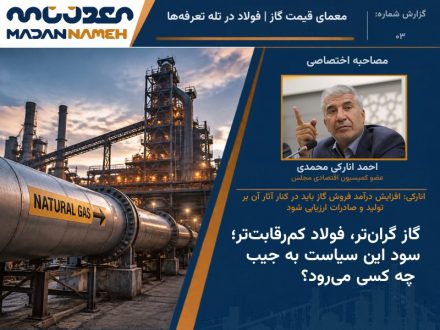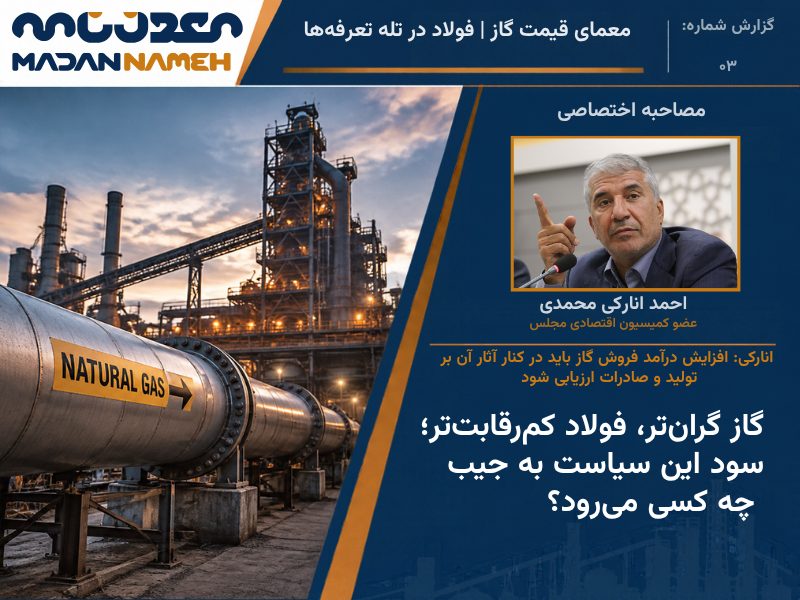
According to the Mining News Agency, the rise in gas costs and the intensification of energy supply constraints have put the steel industry in Iran in a situation where the issue is no longer just the increasing bills for factories. Energy costs are now directly linked to the final prices of products, the profitability of production units, the implementation of development plans, and Iran's ability to participate in export markets.
Ahmad Anarchy Mohammadi, the representative of Rafsanjan and Anar and a member of the Economic Commission of the Islamic Consultative Assembly, emphasized the necessity of simultaneously examining the effects of increased gas tariffs on industrial units and revenue from exports in an interview with the Mining News Agency.
This concern arises at a time when the limitation on gas supply to some steel units began around November 20. Vahid Yaqoubi, the executive deputy of the Iranian Steel Producers Association, announced on November 30 that gas limitations in some units reached 25 to 40 percent. He also warned of the possibility of these limitations intensifying in late December and the months of January and February. Thus, steel producers may face both higher energy costs and reduced access to the necessary gas for production lines in the coming months.
Maintaining export markets becomes more difficult with rising energy costs
Anarchy pointed out that the cost of production is one of the determining factors for the competitiveness of producers in international markets, highlighting the importance of exporting steel products for the country's economy.
According to him, Iran's steel industry benefits from having natural gas resources and developing production capacities based on direct reduction technology, and maintaining these advantages is essential for continued presence in export markets. Increasing energy costs, especially at a time when Iranian producers are also facing transportation costs, financing issues, and difficulties in trade transactions, can undermine their competitive position.
This issue has special significance in the steel export market. An Iranian producer cannot pass on every cost increase to the foreign selling price. The buyer in the global market chooses among different suppliers, and factors such as price, quality, timely delivery, and supply stability play a role in their decision. Therefore, simultaneous increases in gas costs and energy supply limitations can affect exports in two ways: first by raising the total cost, and then by reducing production capacity and making it harder to meet export commitments.
Anarki believes that the effects of the increase in gas tariffs should be examined in terms of the production costs of export products and the profits derived from foreign sales. According to this member of the Economic Commission of the Parliament, steel exports are not limited to selling the product but are also related to earning foreign exchange, maintaining foreign markets, employment, and utilizing the potential of the country's industrial investments.
From this perspective, the economic evaluation of gas tariffs should not be limited to the revenue generated from energy sales. It is necessary to determine what impact changes in the price of this input have on the added value of production, the competitiveness of products, and the country's export revenues.
Producers need tariff stability, not just knowledge of today's price.
Another emphasized point by Anarki is the necessity for stability and predictability in economic and energy policies.
For a steel unit, knowing the gas rate at a specific time is not enough. The factory must be able to predict energy costs in its production, sales, and investment plans. This necessity is even more important for development plans because the return on investment in the steel industry depends on multi-year periods, and unforeseen changes in energy costs can affect the economic calculations of a project.
The representative of the people of Rafsanjan and Anar emphasized the transparency of pricing foundations, the clarity of tariff review periods, and the timely announcement of changes to industrial units. In his opinion, using long-term contracts and predictable mechanisms for securing gas can assist producers in financial planning and investment decision-making.
In addition to the issue of price, the limitation on gas supply also imposes independent costs on the factory. When production decreases, the fixed costs of the industrial unit are divided among a smaller quantity of product, resulting in an increase in the cost price per ton. Stopping and restarting production lines may also incur other technical and operational costs.
Under such circumstances, the producer faces not only an increase in gas tariffs but also costs arising from the reduced capacity of the factory's operations. Therefore, the stability in energy delivery is as important as the predictability of its price.
Support for production should not be limited to providing bank facilities.
In another part of this conversation, Ahnaki emphasized the necessity of transparency regarding the sources and mechanisms of support for industrial units.
According to him, before implementing support programs, it should be clarified which units will receive support, from where the necessary financial resources will be sourced, and how much these supports can help sustain production and maintain employment.
From the perspective of this member of parliament, a combination of correcting imposed costs and targeted financial support could be more effective than solely relying on bank facilities.
This matter is significant given that rising energy costs, reduced production, and export limitations can lead to a liquidity shortage for factories. Working capital facilities may alleviate some of this pressure, but if the main factors driving up costs remain, obtaining loans alone will not resolve the economic issues of the production unit.
Therefore, in designing support policies, it is essential to differentiate between compensating for the damages incurred by businesses and correcting the conditions that lead to a continuous increase in production costs. Financial support will be more effective when there is also a clear program for maintaining stability in production and preventing the recurrence of economic pressures.
The gas tariff should be evaluated in the context of the overall economy
The discussion about gas prices in the steel industry goes beyond the relationship between the energy supplier and the consumer factory. Increasing the tariff may generate more revenue from gas sales, but assessing its economic outcome requires examining the potential effects on production, exports, employment, profitability of firms, and tax revenues.
Anarki believes that the Economic Commission of the Parliament should examine the gas tariff issue from the perspective of this set of effects to determine what consequences the energy pricing policy has for the country's economy.
If an increase in gas prices is accompanied by reduced production, a decline in exports, or limited investment, one cannot make a success judgment solely based on the growth of revenue from energy sales. Conversely, keeping gas prices low without regard to the actual production, refining, transfer, and infrastructure development costs cannot be a sustainable solution either.
The issue is achieving a mechanism that considers the costs of energy supply but does not undermine the advantage of industrial production with sudden and unpredictable changes.
This issue is of greater importance for Iran's steel industry; because a significant portion of the country's production capacity is based on direct reduction, and natural gas plays a crucial role in the production of sponge iron. Therefore, the future competitiveness of steel is not only dependent on the nominal capacity of factories, access to iron ore, or investment volume; sustainable energy supply and the predictability of its cost are also decisive in the continuation and development of this industry.
Anarki's statements come at a time when steelmakers are facing not only rising energy costs but also physical constraints on gas supply. Such a situation increases the necessity to examine the effects of tariffs in the Parliament's specialized commissions.
The main question now is whether the gas pricing policy can provide both the necessary resources for energy supply and infrastructure development, and maintain the competitive advantage of industries that have built a significant part of the country's investment and export capacity based on access to this energy.
For Iran's steel industry, the answer to this question is not limited to the tariff rate for each cubic meter of gas. What matters is the actual cost of producing each ton of product, the stability of factory operations, and the competitiveness in both domestic and foreign markets. Energy policy serves national interests when it not only meets the gas sector's needs but also allows for the continuity of production and the preservation of the country's export markets.