Ehsan Ranjbaran_ News agency «Madan Nameh»: The steel industry of Ukraine has faced one of its most severe crises in recent months since the collapse of the Soviet Union. Since August, missile attacks on four main steel facilities in the country have led to the halting of factory operations and the deaths of 23 staff members and personnel associated with these units. The Financial Times has reported that these attacks have completely halted Ukraine's steel production for the first time in the post-Soviet period.
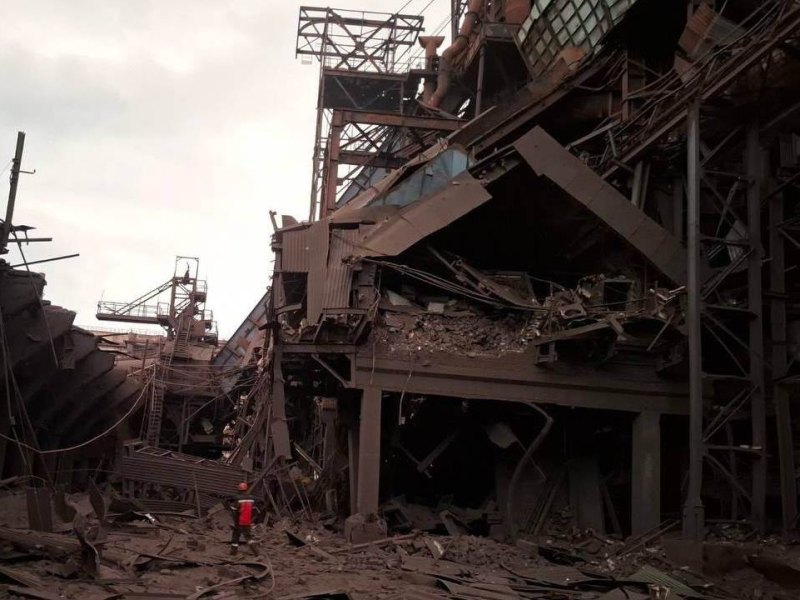
Among these units, the ArcelorMittal Kryvyi Rih factory has experienced a different situation. This facility, which is considered one of the largest integrated steel complexes in Ukraine, has not only stopped production following several missile attacks but has also entered a 'cold shutdown' process aimed at preserving equipment for potential future resumption.
According to ArcelorMittal, this facility faced four missile attacks over a five-week period, resulting in five fatalities and 17 injuries during the attacks. The company announced on September 25 that under the current conditions, a safe and sustainable restart of the factory is not possible.
The Financial Times report provides further details on the scale of this shutdown. According to this report, the Kryvyi Rih factory has been targeted by a total of 19 ballistic missiles, and its two active blast furnaces have been damaged. In total, six employees and contractors of this facility have been killed in the attacks.
Shutting down such a facility is not a quick and simple process, unlike stopping a regular factory. Kryvyi Rih encompasses a complete chain from iron ore extraction to steel production, and a significant portion of its equipment operates around the clock. To prevent further damage, coke batteries are being gradually cooled, thousands of kilometers of pipes and transmission lines must be drained and purged with nitrogen, and machinery will undergo protective operations to withstand the cold months of the year. This process is expected to continue until December.
After the cold shutdown operations conclude, about 1,500 people will remain in the complex for maintenance and protection of the equipment. About 14,500 others will be sent home but will still remain on the company’s employee list and will receive about two-thirds of their salaries.
The significance of this shutdown is not limited to the amount of lost production. Kryvyi Rih is a city with a population of about 550,000, and a large part of its economy has been shaped over decades by iron ore extraction and the steel industry. According to information presented in a Financial Times report, ArcelorMittal provides about 30 percent of Kryvyi Rih's city budget, and the factory shutdown could transfer its impacts from within the steel complex to city revenues, public services, employment, and hundreds of dependent businesses.
This dependence exists in many industrial cities of Ukraine. A significant part of the steel and mining industry in the country is concentrated in the southern and eastern regions, which, due to wartime conditions, have limited options for replacing industrial activities. Stanislav Zinchenko, head of the GMK Center, has warned that the continued closure of factories could lead to the exodus of residents from these areas and the formation of what he describes as 'zombie cities.'
Production statistics also reflect the depth of this crisis. According to data from the GMK Center, Ukraine's crude steel production in September 2026 reached only 131,000 tons, which is a 52.7 percent decrease compared to the previous month and a 78.5 percent decrease compared to the same month last year. Pig iron production also reached 113,000 tons, and finished rolled products recorded 137,000 tons.
The Institute of Economics of the Kyiv School of Economics has also stated that the metallurgy industry has practically lost its significant role as a pillar of Ukraine's export economy. The value of metal exports fell to 190 million dollars in August, and in September, weaker signs of industrial activity were observed. This institute emphasized that the issue is not just the reopening of export routes; a significant part of the production capacity is damaged, and restoring production requires rebuilding and reducing the risk of destruction.
The problems of Ukraine's steel industry are not only due to missile attacks. Even before the escalation of attacks, the industry faced increasing electricity costs, loss of access to cheap coal, logistical constraints due to the closure of Black Sea ports, and restrictions on steel imports to the European market. Therefore, the war has transformed a set of structural problems into a crisis for continued operations.
Regarding ArcelorMittal Kryvyi Rih, the company has emphasized that the decision to shut down does not mean leaving Ukraine, and its goal is to maintain infrastructure for potential restart after the war ends. However, the CEO of the company has warned that if the stoppage is prolonged, restarting will require significant investment, and skilled workers may seek other job opportunities in the meantime.
This issue is especially significant for a capital-intensive industry like steel. A halt in production does not only mean shutting down furnaces; it also affects a chain of mining, transportation, maintenance, raw material supply, technical services, and local businesses. In such conditions, the longer the downtime, the harder it will be to restore the industrial chain to its pre-war state.
On the other hand, the decrease in steel production in Ukraine can also weaken the country's position in regional and European markets. Even if export routes return to normal conditions in the future, a factory with damaged equipment, a lost workforce, and a need for heavy investment to restart cannot immediately return to its previous capacity.
The experience of Kryvyi Rih shows that the war's damage to the steel industry is not just limited to lost production or destroyed equipment value. In cities where their economies have been based on mining and steel for several generations, the shutdown of a large complex can also affect the economic and social structure of the city. For this reason, the steel crisis in Ukraine has now transcended an industrial crisis and has become a matter concerning the future of industrial cities. The survival of these cities depends on the continuity of mining activities, steel factories, transportation networks, and the extensive supply chain. If this chain breaks down for a long time, reconstruction will not be limited to repairing furnaces and production lines; rather, restoring the workforce, capital, related businesses, and urban revenues will be equally difficult.
In this context, Kryvyi Rih has become a warning example where a steel complex is not just a factory but one of the main pillars of urban economy. The shutdown of its furnaces could be a picture of the future for areas where industry has been a direct target of war.