
Story views: 1
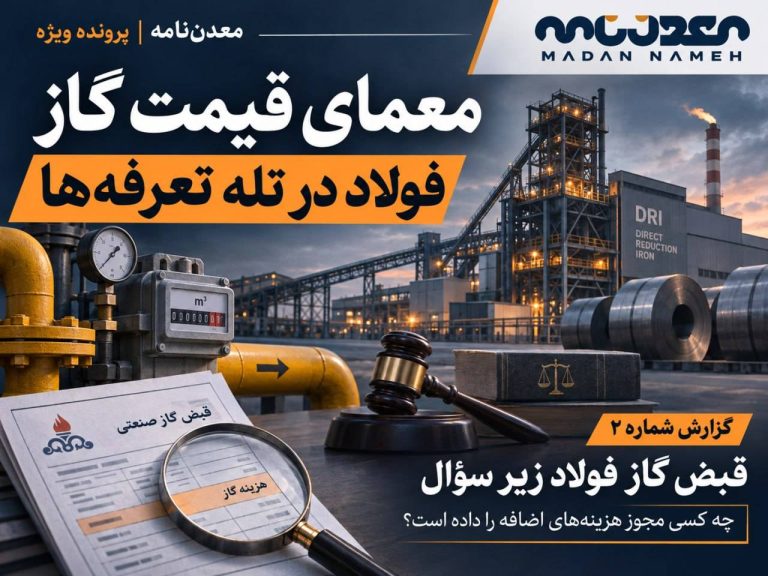
According to the news base “Madannameh“, the increase in gas prices for direct reduction units is no longer just an issue of changing a tariff. Sponge iron producers face growing energy costs, with the final gas cost potentially being significantly higher than the base rate announced by the Ministry of Oil. The base gas rate for these units reached 178,493 Rials per cubic meter in September 1405 (Iranian calendar). However, in one of the steel industry’s calculation documents examined by Madannameh, by adding transmission and distribution costs, gas delivery fees, and taxes, the final amount comes to about 249,533 Rials. The difference between the two amounts is nearly 71,000 Rials per cubic meter. This mathematical calculation, assuming a summation of three percentages, is correct, but it cannot yet be considered the definitive and legal total of a real invoice. The more important issue is the basis for each of these charges and how they are calculated. In an industry where natural gas plays a fundamental role in the sponge iron production process, the difference between the base rate and the final amount can significantly affect production costs and companies’ cash flows. Therefore, reviewing the legality of these bill items is as important as examining the pricing formula itself.
Transmission and Distribution Costs; Regulations That Were Twice Challenged
One of the most important issues in this case is the transmission and distribution cost of gas. In the price justification and calculation documents provided to Madannameh, these costs were cited at 14.9% and 14.8%. To assess the legal backing for these charges, one must refer back to the 1404 budget executive regulations. On 14 Aban 1404, the Cabinet approved the executive regulation of paragraph “P” of Note 13 of that year’s budget law. Article 6 of this regulation anticipated charging part of the transmission and distribution costs from subscribers beyond the approved tariffs. However, this clause was later legally challenged. On 31 Farvardin 1405, the Speaker of Parliament informed the President that charging transmission and distribution costs beyond tariff rates did not comply with the law in some respects. The objections raised included the addition of a clause exceeding the law and the lack of legal authorization for charging fees according to the subsidy organization’s approved instructions. The method of payment and allocation of resources was also criticized. In Ordibehesht 1405, the government amended Article 6, replacing the phrase about charging beyond tariffs and the previous instruction mechanism with wording requiring compliance with relevant laws and regulations.
However, this issue was not confined to just one year. The 1405 budget executive rules also foresaw charging some transmission and distribution costs in the third part of Article 49. Once again, the Speaker of Parliament objected to the phrase regarding charging beyond the approved tariffs. The Cabinet on 31 Khordad 1405 revised the text of this part. In the amended version, charging part of the transmission and distribution costs is still based on consumption volume, but the phrase referring to charging beyond tariffs was removed and compliance with relevant laws and regulations was made a condition.
This back-and-forth between the government and the parliament carries legal significance. When the method of collecting fees from industrial consumers is objected to in two consecutive years and the government revises the provisions, the matter cannot simply be viewed as an accounting disagreement. Nevertheless, the parliamentary objection does not imply that all transmission and distribution costs for all periods were illegal. It must be clarified under which regulatory version each invoice was issued and what other valid instructions formed the basis for the amount charged. A question still unanswered is the source of the 14.8% and 14.9% rates. In the amended Article 49 of the 1405 budget executive rules, these rates are not explicitly specified. Therefore, the National Gas Company must clarify how such rates are calculated, whether they are uniform for all subscribers, and since when they have been enforceable. It must be especially understood if transmission and distribution costs are calculated based on the base gas price, the actual cost of transmission services, or a separate formula. These distinctions are more than semantic; each approach can result in different final amounts charged to producers.
10% Delivery Fees and 15% Tax; What Does the Law Say?
Besides transmission and distribution costs, two other items appear in industrial gas calculations and must be differentiated. First, a gas delivery fee amounting to 10% of the consumed gas price. Article 65 of the Law on the Addition of Certain Provisions to the Government’s Financial Regulations (2) authorizes charging this fee from natural gas subscribers, except for petrochemical feedstock consumption. Therefore, the existence of the 10% delivery fee has a clear legal basis, although the amount on each bill should still be verified against the calculation base and valid regulations for each period.
The second item is tax and value-added tax (VAT). In the steel industry calculations presented, a 15% figure is mentioned as “value-added tax on transmission cost.” Reviewing the VAT law text shows a need to distinguish between VAT applicable to natural gas sales and possible VAT on transmission services. According to clause “A” of Article 26 of the VAT law enacted in 1400, a special 15% rate applies to natural gas. Hence, unlike possible assumptions comparing to the general VAT rate, the mere presence of a 15% rate is not necessarily unlawful. The general VAT rate in 1405 is 10%, but special legal rates exist for certain goods including natural gas.
However, having a 15% legal VAT rate for natural gas alone does not confirm that applying the same rate to transmission and distribution costs is correct. It must be clear whether the labeling in the presentation accurately reflects the invoiced item, or if it’s simply a misnomer for a calculation. If the 15% tax is charged on the sale of natural gas itself, the legal basis differs from a case where the same rate is independently applied to transmission services. Furthermore, clarity is needed about the taxable base and whether the tax base includes other items as well. To make a definitive judgment, a full official invoice and the National Gas Company’s tax instructions must be disclosed.
Another important issue concerns direct reduction units and their financial implications. Clause 3 of paragraph “A” in Article 26 of the VAT law provides for the acceptance of paid taxes and duties on goods mentioned in that clause as a tax credit, specifically when these goods are used as main raw materials in production units. Technically, natural gas in the direct reduction process is not merely a heat source; it also produces reducing gas. However, this technical fact does not automatically entitle all reduction units to tax credits. It must be examined how gas consumption is classified under tax regulations, what documentation is required as proof of use as a main raw material, and if the tax authority has clear interpretations or circulars. This issue deserves thorough examination because even if the tax is properly charged, the method of accepting tax credits can impact the company’s final financial burden.
Late payment penalties should also be considered separately from gas consumption tariffs. Clause 2 of Article 49 of the 1405 budget executive regulations provides that the calculation of penalties for non-residential consumers’ gas bill arrears refers to the penalty rate of Article 190 of the Direct Taxes Act. The rate mentioned is 2.5% per month delay. This sum is a penalty on overdue debt and cannot be added to the regular cost per cubic meter of gas without an outstanding matured debt. Moreover, when there are uncertainties about the validity date of rates or amounts of differences, the method of determining the penalty start date itself becomes a subject for review.
Administrative Justice Court Ruling; A Precedent That Cannot be Ignored
The importance of legally examining gas invoices is not limited to current disputes. The Administrative Justice Court’s General Board in ruling number 140531390001508044 dated 17 Shahrivar 1405 annulled two letters related to industrial gas rates for 1403. The ruling followed a complaint by Saadat Nassajan Yazd company. The complaint concerned the letters dated 17 Bahman 1403 from the Oil Ministry Planning Deputy and 21 Bahman from the National Gas Company, which applied retrospectively to earlier periods of 1403.
The court stated that regulatory bodies have a legal mandate to set gas rates; however, retroactive application of regulations, as in the case under review, conflicted with Article 4 of the Civil Law. Accordingly, the contested letters were annulled. The ruling’s significance for industries lies in clarifying that the legal right to determine prices does not imply unlimited authority to retroactively apply regulations or claim differences for past periods.
This legal precedent raises a clear question for direct reduction units: Have any corrective bills or difference claims based on delayed notifications been issued for the years 1403, 1404, or 1405? If so, the approval and notification dates of rates, consumption periods, invoice issue dates, and basis of claims must be examined together. Note that the Shahrivar 1405 ruling did not nullify the gas pricing formula or all tariffs over these three years. The legal effects on other bills and the potential refund of any excess ultimate payments require detailed analysis of each claim and an appropriate legal process.
Meanwhile, a fundamental principle must not be forgotten. The steel industry cannot plan its production costs based solely on an unknown final gas bill amount. A production enterprise requires a predictable mechanism for making decisions about production volume, sales, working capital, maintenance, and investment. The base rate increase on the one hand, and ambiguity about how certain items are calculated on the other, complicate accurate cost evaluation. This is especially important approaching winter, when the risk of gas delivery restrictions adds to the uncertainty of extra costs.
A Clear Demand from the Ministry of Oil and National Gas Company
Madannameh does not claim that all additional items on the gas bills are unlawful. Document review confirms that some, such as gas delivery fees and specific taxes on natural gas sales, have clear legal foundations. In contrast, questions remain about the determination of transmission and distribution charges, their compliance with amended regulations, and the taxation method applied to different bill items.
To resolve these ambiguities, the Ministry of Oil and the National Gas Company should publish a complete and reproducible sample calculation of a direct reduction unit’s invoice. The calculation must specify separately the base rate, consumption amount, transmission and distribution costs, gas delivery fees, taxes and VAT, and any penalties, along with the legal basis, taxable base, calculation method, and regulation effective date. Additionally, publishing the instruction for determining transmission and distribution costs and clarifying the difference between the 14.8% and 14.9% figures is essential. If the National Gas Company has valid documents backing these charges, publishing them could resolve much of the current dispute.
The Iranian Steel Producers Association and direct reduction companies can further assist by releasing non-confidential data from actual bills to enable independent calculation verification. Without these data, neither the exact amount collected industry-wide can be estimated nor the existence of excess charges reliably confirmed.
The main issue is not the request to eliminate all lawful energy costs. The production and transmission costs of gas are real, and financing the gas network is necessary. However, every charge imposed on producers must be legally grounded, transparently calculated, and allow the industry to reasonably predict energy expenses to avoid heavy debts.
In a situation where direct reduction units face rising gas prices and the risk of supply limitations in the cold season, transparency in billing is not a trivial matter. The key question is: When the law sets conditions for collecting fees from industry and parliament has objected to parts of executive regulations, which authority is responsible for proving the accuracy of the final gas bill amount for steelmakers?
Madannameh will follow up on documented responses from the Ministry of Oil, National Gas Company, Tax Administration, and other responsible entities in ongoing coverage of this matter. Defending the continuity of sponge iron production cannot be complete without clarifying the actual and legal cost of gas supplied to factories.
Sources and Documentation of the Report
1. The Law on the Addition of Certain Provisions to the Government’s Financial Regulations (2), especially Article 65 and gas pricing regulations.
3. 1405 Budget Executive Regulations with subsequent amendments, especially Article 49.
4. Article 26 of the VAT Law enacted in 1400.
5. Ruling No. 140531390001508044 of the Administrative Justice Court General Board.