
Story views: 2
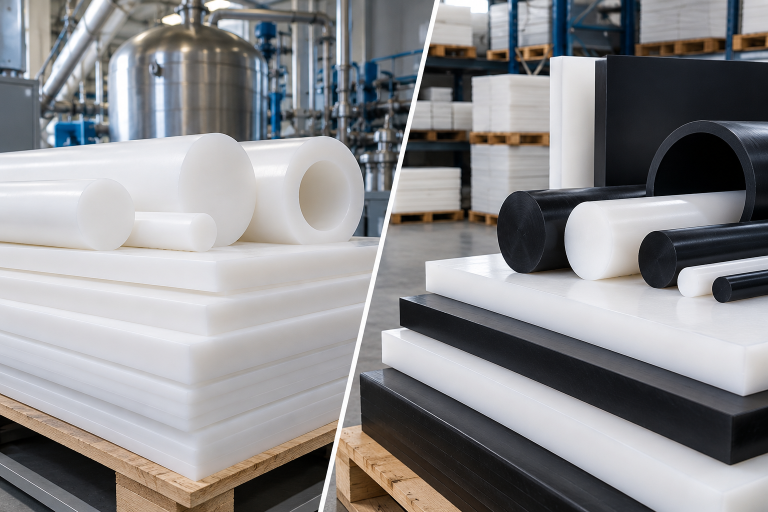
Teflon Sheet or Polyethylene? Technical Criteria for Selecting the Appropriate Material for Production Lines and Industrial Part Manufacturing
In many machining workshops and production units, the question “Should we buy Teflon sheet or polyethylene?” is repeated every few months. The short answer is: if the temperature is high and the chemical environment is aggressive, PTFE, and if abrasion resistance and impact toughness at a reasonable cost are important, polyethylene. However, the correct decision depends on more detailed factors, which are reviewed below.
Why does choosing the wrong engineering polymer cause costly problems in industry?
At first glance, engineering polymers appear similar: white or cream-colored sheets that can be cut and machined with common tools. But their behavior under real working conditions differs greatly. A part that softens at high temperature, a guide or liner that wears out prematurely, or a washer that deteriorates when exposed to acid can each lead to production line stoppage and replacement costs.
Much of these problems stem from choosing based on price or habit rather than working conditions. Therefore, before any purchase, temperature, chemical environment, mechanical load, and type of part movement must be clarified.
Comparison of Teflon sheet and polyethylene sheet at a glance
Teflon is the trade name of the polymer PTFE (polytetrafluoroethylene). This polymer’s structure is based on carbon–fluorine bonds, which provide very high chemical and thermal stability. Polyethylene, however, is made from hydrocarbon chains, with a density around 0.94 to 0.96 grams per cubic centimeter, while PTFE’s density is about 2.15 to 2.2.
|
Property |
PTFE (Teflon) |
HDPE / UHMWPE |
|
Continuous Operating Temperature (approx.) |
Up to about 260°C |
About 80°C |
|
Chemical Resistance |
Very high |
High, with limitations against some solvents and oxidizers |
|
Coefficient of Friction |
Very low |
Low |
|
Abrasion Resistance |
Moderate |
High (especially UHMWPE) |
|
Impact Toughness |
Moderate |
High |
|
Creep Under Load |
Significant |
Less |
|
Price |
Higher |
More economical |
The above values are approximate and depend on grade and manufacturer. For precise design, the datasheet of the specific grade should be used as a reference.
Polyethylene itself has two main categories: HDPE (such as PE100), suitable for general applications, tanks, and coatings; and UHMWPE (such as PE1000), with very high molecular weight, chosen for highly abrasive environments.
Thermal resistance: which material withstands higher temperatures?
In this criterion, PTFE excels. Teflon maintains its properties over a very wide range, from very low temperatures up to about 260°C. Polyethylene begins to soften gradually at around 80°C and is unsuitable for high-temperature applications. If your part is in contact with steam, hot oil, or warm fluid, polyethylene is usually excluded from the start.
Chemical resistance of Teflon and polyethylene against acids, bases, and solvents
PTFE is almost resistant to all common industrial acids, bases, and solvents, which is why it has a stable position in chemical, plating, and petrochemical industries. Polyethylene also performs well against many dilute acids and bases and is used for tanks and chemical linings, but has limitations against some organic solvents and strong oxidizers. Checking the chemical compatibility table for the specific material before purchase is essential.
Mechanical and abrasion properties: strength, impact toughness, and creep
Here the picture reverses. PTFE is soft and experiences creep or cold flow under permanent load. Therefore, for load-bearing parts, it is usually combined with fillers like glass or carbon. In contrast, polyethylene, especially UHMWPE, performs excellently against impact and abrasion and is widely used in silo liners, chain guides, and wear plates. Both have a low friction coefficient, but PTFE is lower than most polymers in this regard.
Applications of Teflon and polyethylene sheets in various industries
Food and Pharmaceutical Industries: Cutting plates, guides, and packaging line parts are usually made from polyethylene. In sections where heat or stickiness matters, PTFE is used. In both cases, the appropriate food-grade must be selected and documentation obtained.
Chemical and Petrochemical Industries: Washers, gaskets, liners, and sealing parts rely more on PTFE. Polyethylene is used for tanks and lower-temperature linings.
Mining, Transportation, and Pipelines: Liners, guide rails, and wear plates are common applications of UHMWPE.
When is PTFE and when is polyethylene the more suitable choice?
A simple rule can clarify the decision path:
- If the operating temperature is above 80°C or the chemical environment is aggressive, choose PTFE.
- If the main issues are abrasion, impact, and mechanical load and the temperature is normal, polyethylene (especially UHMWPE) is a more logical choice.
- If the part requires welding or structural fabrication, polyethylene is easier to work with.
- If budget is limited and working conditions are not harsh, polyethylene usually has a lower total cost.
In borderline conditions, consulting a supplier who offers both materials is cheaper than trial and error.
Supply of engineering polymer sheets and rods in Iran: Domestic production and imports
The Iranian market has a different structure for these two material families. Polyethylene sheets and polyethylene rods are produced domestically, which provides advantages in availability, shorter lead times, and the possibility of various dimensions. In contrast, Teflon sheets and PTFE rods are mostly imported, and their quality depends on the raw materials and manufacturing processes of the foreign supplier.
Pars Polymer company operates with a dual approach: it produces polyethylene sheets and rods and imports Teflon sheets and rods. This combination offers an operational advantage to industrial customers; they can review and compare both options from a single source and decide based on real needs.
Important points when buying Teflon and polyethylene sheets and rods
1. Specify the grade. Virgin and recycled materials significantly differ in properties and quality stability. For sensitive applications, virgin material is the better choice.
2. Request datasheets. Technical specifications, density, strength, and if necessary, food contact certificates must be available.
3. Check dimensions and tolerances. For precise parts, the actual thickness and uniformity of sheets or rod diameter are very important. Consider machining allowance.
4. Include machining in cost estimation. Teflon requires proper tools and strict control; its creep must be accounted for in tolerance design.
5. Evaluate the supplier’s background. A supplier who can guide in grade selection and offer after-sales support reduces purchase risk.
6. Evaluate price alongside quality. Price differences due to raw material or manufacturing often reflect in the part’s lifespan.
Summary: selecting material based on working conditions
PTFE and polyethylene are not absolute competitors. Each is the best choice under specific conditions. PTFE suits high temperatures and harsh chemical environments, polyethylene suits abrasion, impact, and economically sensitive projects. The right decision starts with gathering accurate information about temperature, environment, load, and cost and is completed by selecting a supplier familiar with both options who can provide technical documentation. For product consulting and technical advice, you can refer to the Pars Polymer website.
Frequently Asked Questions
What is the main difference between Teflon sheet and polyethylene sheet?
Teflon is more resistant to temperature and chemicals and has very low friction. Polyethylene is cheaper, has better impact and abrasion resistance, and is easier to machine and weld.
Up to what temperature can Teflon sheets be used?
PTFE’s continuous operating temperature is about 260°C. The exact value depends on the grade and mechanical load.
At what temperature does polyethylene soften?
The continuous operating temperature of common types is about 80°C.
Is polyethylene sheet suitable for food contact?
Food-grade variants are suitable, provided the supplier offers certification or specifications.
Which is better for sliding parts and guides, Teflon or polyethylene?
For heavy load and high wear, UHMWPE is usually more economical. For high temperature or corrosive environments, PTFE is the better choice.
What is the difference between HDPE and UHMWPE?
UHMWPE has a much higher molecular weight and provides greater abrasion and impact resistance.
Is Teflon sheet machinable?
Yes, but due to softness and creep, proper tools and tolerance control are needed.
What documents should be requested when buying polymer sheets and rods?
Technical datasheets, grade specifications, type of raw material (virgin or recycled), dimensional tolerances, and if needed, food contact certificates.