
Story views: 2
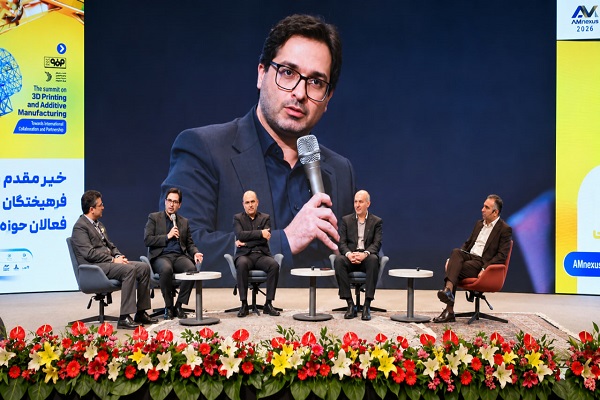
«Madan Nameh News Agency“: Alireza Rahim, CEO of Hormozgan Steel Company, stated during the Emerging Technologies and the Policies Panel of the Mobarakeh Steel Group at the first National and Specialized Gathering on the Additive Manufacturing Supply Chain, held with the presence of knowledge-based companies, technology experts, industry representatives, and investors: Hormozgan Steel Company has experienced an extraordinary first six months this year in terms of production statistics, revenue, and profitability. However, we should not continue on this path because the world is charting and following a different course for the steel industry.
He added: The importance of technology and innovation in the steel industry cannot be denied. Although the topic of technology and innovation has been raised in our country for several years, we have not been successful in commercializing it. Despite very good progress in technology across our country, only a very small fraction of it has been commercially integrated into the industry.
Technology Gap; a Challenge Beyond Equipment Development
The CEO of Hormozgan Steel Company raised the question of who is responsible for the technology and innovation sector, emphasizing: Three key priorities for the Mobarakeh Steel Group as a leading entity have been correctly identified based on foresight studies. These have, of course, already been implemented in advanced industries worldwide. It is worth noting that our country’s industries lag behind the world by 10 to 20 years in some domains of technology and innovation. Therefore, at the outset, we need to bridge this gap by looking ahead.
Rahim stressed: We believe that if the technology and innovation sector operates in parallel alongside companies within organizations, it will never be effectively implemented. Until technology is institutionalized inside companies and organizational structures are designed and executed accordingly, we cannot hope to realize new technologies and innovations in the industry.
Innovation Must Become an Organizational Culture
He continued: Technology and innovation can be operationalized and implemented in companies only when this topic is deeply embedded within every employee and becomes an organizational culture. Employees must be familiar with new concepts in technology and innovation. This will occur when the minds and perspectives of employees adapt to new technologies. It is impossible to expect new technological and innovative achievements with outdated thinking.
The CEO of Hormozgan Steel Company emphasized: Youth must be empowered in the technology and innovation field as they are the ones who can bring transformation to companies, industry, and the national economy.
Rahim added: If CEOs adopt a knowledge-based perspective, the chances of success will be high. Until technology and innovation are institutionalized, operationalized, and tangible within an organization, it is not possible to envision a successful outlook. Otherwise, like many half-finished and failed projects, the organization itself will fail.
Smartification Is Not Possible Without Accurate Data
He stated that for the smartification of a factory, proper data must exist, and without accurate data, it is not possible to take steps towards smartifying companies, commercializing technology and innovation, and implementing projects. Tata Steel, as a pioneer in artificial intelligence, dedicates 80% of its efforts in smartification to historical data.
The CEO of Hormozgan Steel Company, emphasizing understanding the problem statement in technology and innovation, remarked: The issues and challenges of steel companies differ depending on many variables, and a single solution cannot be prescribed for all companies. Additionally, as mentioned, until technology and innovation are institutionalized within the organization, all strategies and plans in this field remain only on paper.
From Training Specialized Forces to Setting up a Technology and Innovation Observatory
Rahim noted the efforts of Hormozgan Steel in technology and innovation: Hormozgan Steel has entered this field to train human resources and has established an industry-adjacent technical high school for technician training. Additionally, to close the gap between universities and industry, the “Bright Tomorrow” program known as “Fara” has been implemented in cooperation with Hormozgan University, whereby from this year, 30 students including 15 metallurgy and 15 mechanical engineering students will be sponsored and will complete 40 practical units at Hormozgan Steel.
He acknowledged: While the entire country was at peace and under ceasefire, conflicts continued in the southern region; nevertheless, during that time, Hormozgan Steel launched the Technology and Innovation Observatory at the Hormozgan Science and Technology Park. Despite some limitations due to geographic and situational conditions, with the help of elite youth, we managed to find solutions for certain issues in information technology, artificial intelligence, and digital transformation.
The CEO said: The Hormozgan Steel Technology and Innovation Observatory allows us to utilize the capacities of elite young people to solve longstanding production, process, and IT challenges, and we will certainly keep this path open.
Technological Investment; A Long-Term Path With Economic Returns
Rahim concluded by stating that the return on investment in information technology takes time, noting: Tata Steel has invested approximately two billion euros in information technology and artificial intelligence but has so far received a 1.4 billion euro return on investment. Therefore, investment in this field should not be withheld, and without it, success cannot be achieved. By studying leading companies in research, development, and information technology, their structures can be used as models.